DQC
A published preprint (Zenodo, v4): one bit-exactly reversible integer automaton in which an emergent Schrödinger sector, deterministic double-slit interference, CHSH = 2.79 and a falsifiable Planck-scale prediction all appear as measured, checksum-reproducible behaviour.
DQC (Discrete Quantum Computing) is the hypothesis that, at the deepest level, the physical world is an exact, reversible, integer computation — and a working substrate that takes the hypothesis seriously and tests its consequences. At its core is a Frenkel–Kontorova / sine-Gordon integer automaton (state in ℤ_M, Feistel updates): evolution is a permutation of integer microstates, not approximate numerical integration — which is precisely why the gates can be bit-exact rather than statistical.
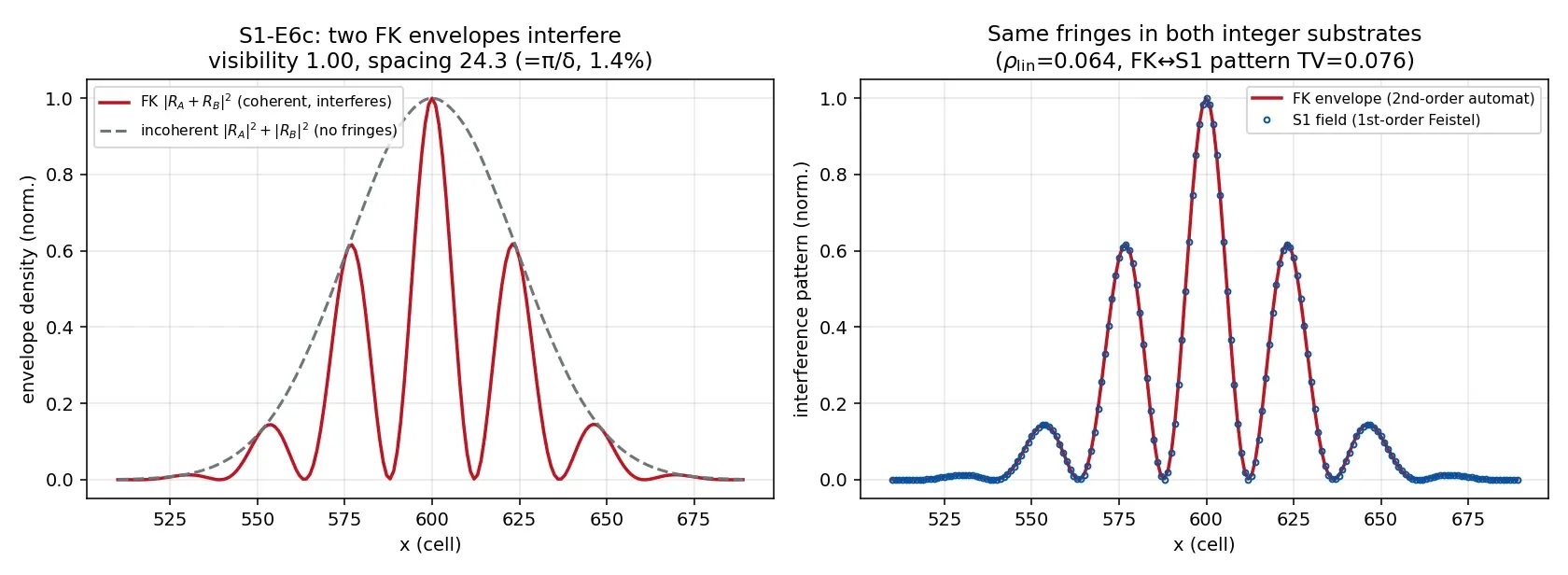
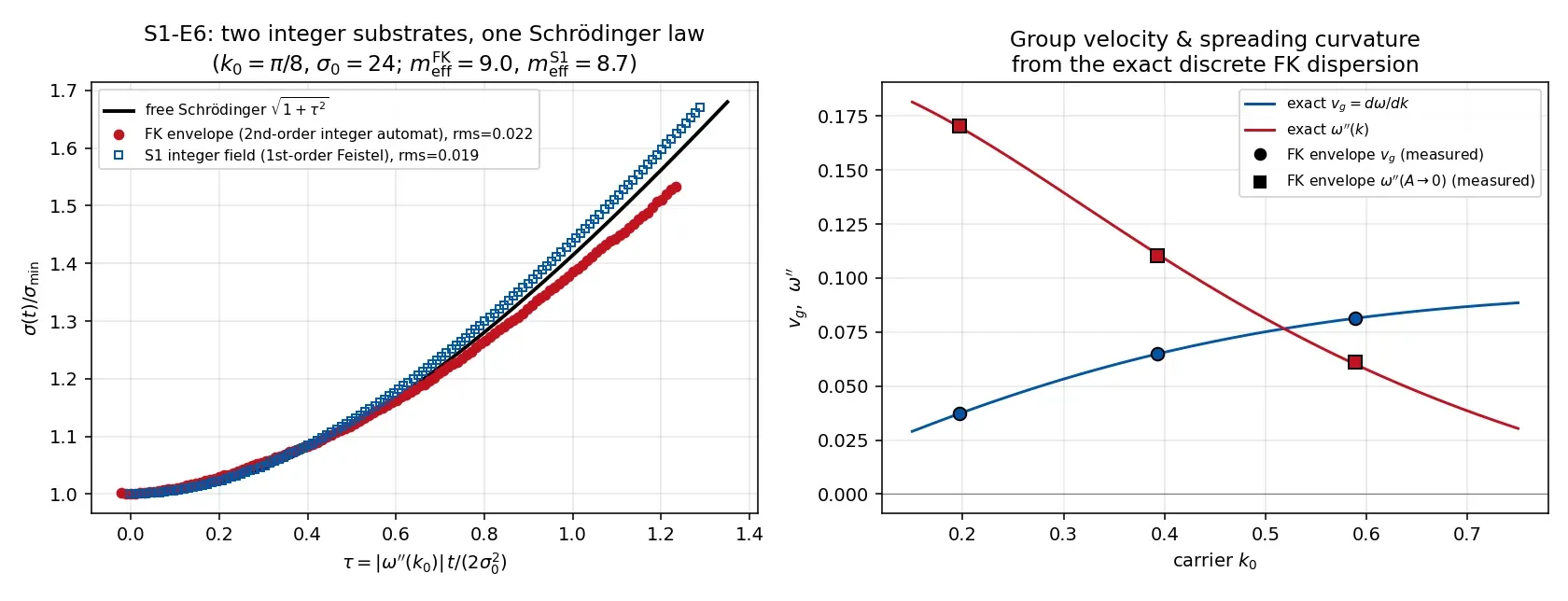
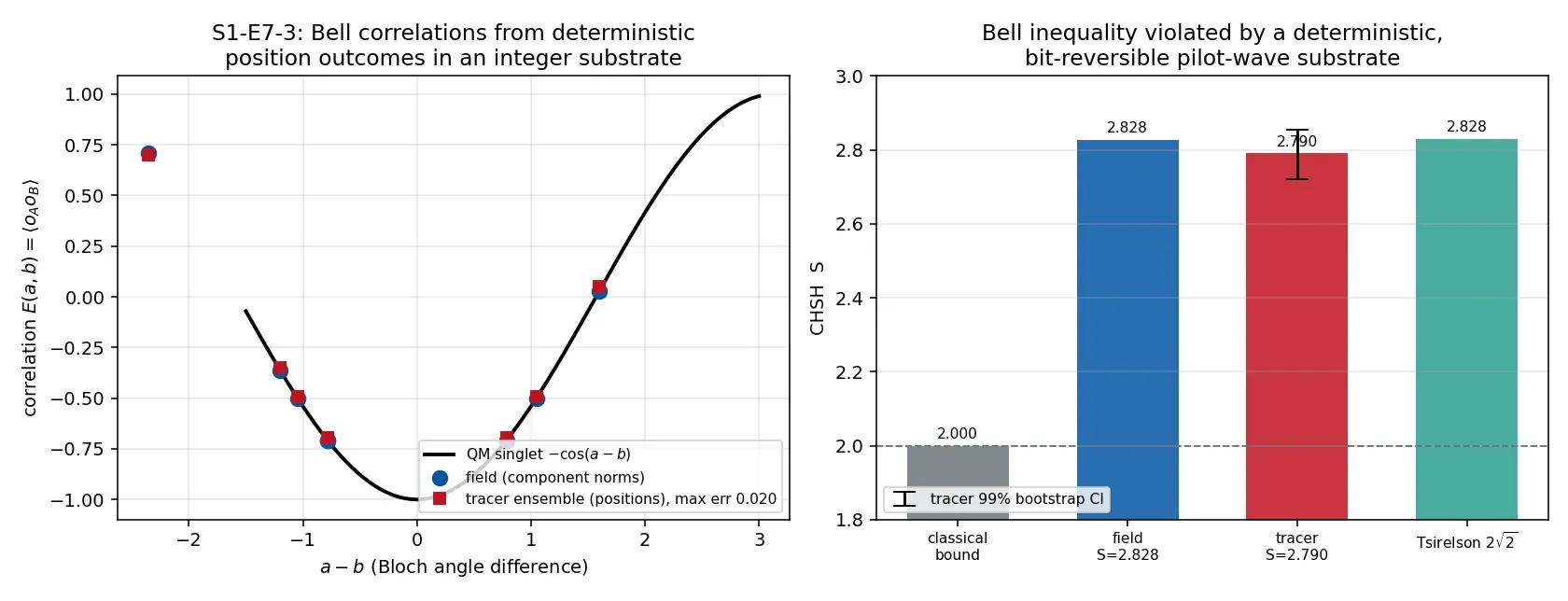
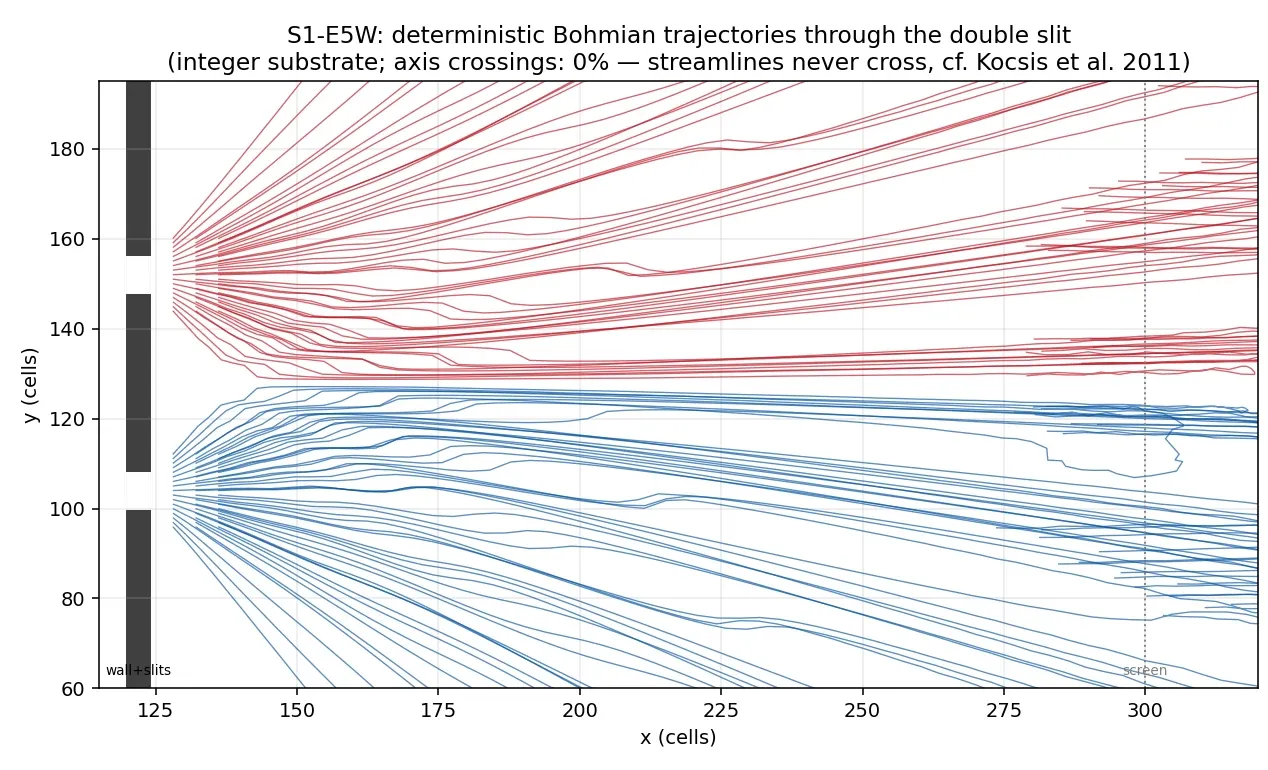
A quantum sector emerges from that classical substrate. The narrow-band envelope obeys the Schrödinger equation with an effective mass fixed by the curvature of the exact discrete dispersion, and two microscopically different substrates collapse onto the single universal spreading law √(1+τ²). Deterministic Bohmian tracers reproduce single-object double-slit interference (p < 10⁻⁴) with trajectories matching the weak-measurement reconstruction of Kocsis et al. 2011; CHSH = 2.79 comes out of position-valued outcomes with no randomness anywhere and a no-signalling control at 0.3 %. Alongside these: exact exchange statistics (Pauli exclusion as a bit-conserved invariant), a quantum eraser with literal bit-reversible un-measurement, and a measured branch-coherence decay law (R² = 0.997).
The project is equally precise about where the boundary lies. The two-particle interaction is substrate-derived (cross-/self-phase ratio 2.31 against a parameter-free prediction of 2), yet the reconstructed state stays Schmidt rank 1 where the L² reference reaches K = 4.9: the substrate derives the Hamiltonian, not the L² state space — entanglement is carried, not derived, and spin is implemented. Velocity anisotropy vanishes as k² in the infrared with first-principles coefficients in both 2D and 3D (≈ 1 %), so rotational isotropy emerges as an infrared fixed point; Bell statistics are foliation-order-independent (|ΔS| < 0.005, S > 2 in every ordering) even though 41 % of individual trajectory pairs flip.
Version 4 adds a dynamic-geometry sector — and reports it together with its obstructions. An exactly conserved geometric ledger forces the static response to be contact-only (the lattice counterpart of Gauss’s law on a compact space), so a two-body force is impossible in that class; a source entering the first-order equation cannot build a static field in any dimension; and four independently probed force channels are blocked. What the ledger does permit: relaxing conservation of the free field while keeping the total exact restores long range without losing bit-exactness, a carry-based binding rule turns “mass = number of bound tokens” into a 1 % measurement, and letting the clocks read a second bitwise-exact Gauss law closes the matter→geometry→matter loop kinematically (a body slows its own clock by 30 %, matching the clock-rate law to 1.3 %, with a causal onset). None of this is general relativity — the geometry is a scalar lapse, no attraction is measured, and the obstruction theorem forbids one in the conserving class.
The one falsifiable prediction is measured on the engine rather than derived from a formula: ξ_iso(3D) = 0.024299 ± 1.1×10⁻⁴ against the exact rational 187/7680 (0.20 %), with the subluminal sign resolved from zero by 221 σ, giving δ_γ,2 = −2ξ/E_Pl² = −3.27×10⁻⁴⁰ GeV⁻². It sits ~30× below the older Lang et al. (2017) bound but is in ~3.3× tension with the conditional Pierre Auger (2022) limit for a source scenario with a subdominant proton component — so it is decidable by UHECR composition measurements, with a threshold signature at E* ≈ 2 EeV. Methodology is a co-equal contribution: criteria are committed to version control before each run (the commit hash is the timestamp), the archive ships the pre-registration designs themselves including changes that failed, and nineteen headline results have been retracted or corrected on record (four in this version). The entire computational effort so far cost ~US$35 of cloud GPU; the whole dynamic-geometry series ran at zero cost on a single host.
This is not a claim that our universe is this automaton — it is an existence proof that such a world can carry quantum phenomenology, quantitatively and reproducibly. The preprint has not yet been independently peer-reviewed; the development repository is private, while the archived snapshot with code and pre-registrations is on Zenodo.
Highlights
- Bit-exactly reversible integer automaton — evolution is a permutation of microstates, not numerical integration
- Emergent Schrödinger sector: two different substrates collapse onto one universal spreading law √(1+τ²)
- Deterministic single-object double-slit interference (p < 10⁻⁴); trajectories matching Kocsis et al. 2011
- CHSH = 2.79 without randomness, with a no-signalling control at 0.3 %; Bell statistics foliation-order-independent
- Rotational isotropy as an infrared fixed point (anisotropy vanishes as k², ≈ 1 % in both 2D and 3D)
- Dynamic geometry reported with its obstructions: an exact ledger forces contact-only statics; “mass = bound tokens” to 1 %
- Falsifiable prediction measured on the engine: δ_γ,2 = −3.27×10⁻⁴⁰ GeV⁻², in ~3.3× tension with the Auger 2022 limit
- Nineteen self-corrections on record; pre-registration before every run; whole project for ~US$35
A guide for the curious
The candidate ladder — where DQC goes next
Eight possible continuations of the programme: the falsifiable prediction the Auger Observatory will decide, the fermion no-go, gravity's missing action principle. Every concept explained from scratch — no physics background needed.
Read the ladder →